Sunday, March 16, 2014

Getting Started with Backyard Chickens - Part 2


The next morning the girls were ready to come out of their sleeping area early morning.  I brought them some treats from the kitchen  since I did not have a chance to pick up feed.  I set out shortly afterwards to pick up some food and materials for a feeder.   I found Mt. Holly Farm Supply to be the closest location for feed.  I decided on the pellet feed since I read that chickens pick out what they like in the scratch and the other parts are wasted.  I was pleased to find that 50 pounds was $13.50. The staff was most helpful and found they were having a Chicken Workshop that we will all attend. I made sure I was aware of what chickens can and should not eat by locating information on the Backyard Chickens website.  I found they will eat almost all kitchen scraps except for raw potatoes/cooked non-green are fine, citrus, under-cooked or dried beans, avocado skin/pits, and salty foods. 


I found they love watermelon, chickweed, and whole kernel corn.  Their favorite by far is the corn and eat it out of my hand.  They will ignore all else when corn is around.  They are trained that went a metal container with coins is shaken corn is coming soon!   I pull up a couple hand fulls of weeds several times a day.  The chickens run up to me each time they see me in hope for more treats!

Betsy, Isaac, and Elise came to see the chickens that afternoon and found they had layed two eggs.  I had not checked earlier so we all were surprised and delighted!  Later on that day they would lay two more.


I decided to use shredded newspaper for the nesting material in the boxes.  It works out well and go right into the compost bin when I clean.  Pictured here are the first two eggs we received the day after they arrived.


They took the eggs home and Isaac cooked the first one and noticed that the yoke was larger than the other eggs they had been eating.  The girls layed four eggs the first day and two daily for the next week.  I enjoyed my first fried egg still warm from the nesting box, you can get any fresher than that!  Recently, we have started to receive 3-4 eggs daily. 


 Pictured are our firsts... the first two eggs, the first, dozen eggs, and the first fried egg! 

Saturday, March 15, 2014

Getting Started with Backyard Chickens - Part 1


Our family members have been discussing raising chickens and bees for a couple of years.  This fall we finally took the first steps to do more than just talk about our vision; my wife, daughter, and son-in-law enrolled in bee school and I purchased of a small chicken coop when I found an excellent deal online.


The coop came and was stored in the two boxes it arrived in until Issac, Steven, and I decided to put it together shortly after the big snow of 2014.  The family stayed at our house during the week it snowed.  This took place several weeks before I had planned so things were moving fast which required immediate reading and learning about chickens.  So while the others were learning about bees I was learning about chickens in a self study through books and Internet sites.  I found the website Backyard Chickens most helpful.  I also used Google Image searches as a place to start for ideas for feeders, water containers, and runs.


Betsy purchases her meat from Farmer Art and shared with him our desire to raise chickens and that we already had a chicken coop and wanted his advice for our next step.  He shared that he works with Farmer Tim who was needing to thin his flock in preparation for new chicks that would arrive soon.  We contacted Farmer Tim and set up a time to visit his farm and bring home our new pets.  The weather was perfect and it was so exciting for us all to be on a real farm that had cattle, goats, and chicken.  We were able to see so many different breeds of chickens.


We took quail and pet cages to house the chickens on the way home.  Farmer Tim had picked out two Rhode Island Reds and two Dominique chickens to start our backyard flock.  Since all this happened faster than I expected, I had to used a makeshift run that I created out the plastic fencing we used to keep Isaac and Elise from going into the street and some plastic netting for the top.  Isaac, Elise, and I wondered how we were going to be able to get the chickens into the coop. 


I finally pulled the run away from the coop and put the chickens into the coop.  Farmer Tim said it would be best to leave the chickens in the coop for a day or two so they would know it was their home.  This was wise advice and the chickens quickly made the coop their home.  Isaac and Elise fed the chickens their first meal.  We all were surprised that the chickens started eating as soon as the vegetables hit the ground.  I was not sure if the chickens would know how to get the water out of the bottle so we put a bowl of water inside and left them alone.

Robin and Steven came to see the chickens when they arrived home from work.  Steven really wanted to hold a chicken so he decided on one of the Rhode Island Reds.  Robin petted the girl while Steven was holding her.  We were all amazed that the chickens knew to go into the coop's nesting and roosting area at dark.


Thursday, July 04, 2013

My Journey to Raised Bed Gardens

This picture is of my first garden in the late 1970s in field between Nana's and Uncle Gary Thornburg's houses.  We were successful in our gardening experience.   Gary plowed the garden for us to use. The top picture was shortly after planting and below is the garden at harvest time.
In 1981 I read Square Foot Gardening by Mel Bartholomew which encouraged me to start gardening at my house using raised bed.  From that point I never turned back from using raised beds for my gardening method of choice.  I am currently reading the All New Square Foot Gardening e-book on my Kindle.  For a better idea of the square foot gardening technique, view this presentation.   The picture below is my first attempt of gardening in raised beds in the late 1980s. 

Benefits or raised beds include:
  • Better drainage
  • More useable growing space
  • No soil compaction from walking on it
  • Easier to keep weeded since your focus is just one raised bed at a time
  • Soil is warmer than surrounding ground making for a longer season
  • Soil that has basically a neutral pH unless you add something to change it 
  • Less soil erosion
Each year I learn more about how to best garden.  I plan my beds thinking how to go from crop to crop.  You can see in the picture above how I planted the lettuce between my tomato plants that will take over towards the end of the lettuce season. Recently I learned that most of the bulb of the onion needs to be above ground for them to grow large.   I could really tell the difference in the 2012 and 2013 onion crops.
The process is simple...
  • Locate a sunny flat area
  • Secure 2x8 untreated lumber that can form a rectangle, for some of my beds I used concrete blocks
  • Cardboard boxes to cover grass for the bottom of the bed if starting on a lawn
  • Soil mixture consisting of 50% screened topsoil and 50% high-quality compost that are mixed together as you add them to your bed.  For the top 4-6 inches I use Mel's Mix developed by Mel Bartholemew - 1/3 coarse horticultural vermiculite, 1/3 peat moss, and 1/3 blended compost.  I have also used Miracle Grow Garden Soil to top the bed off at the start of the season.
  • Composting goes hand-in-hand with gardening.  I have three going all year.  One is a large compost bin 3' x 3' for large yard waste.  I have a tumbler that is making compost right now from Fall 2012 scraps and a large ball tumbler, pictured above, that I am putting kitchen and some small yard scraps in at this time.  Pretty soon the compost from one will be ready for the garden.  Once emptied, I will start filling that one with new kitchen waste and let the ball tumbler finish the composting process.
  • The Internet has a vast collection of raised bed websites and YouTube contains videos that can help you get started!
Here are pictures of my 2013 gardens.


This is my newest raised bed of the dozen I have in my yard.  This one consists of three side-by-side beds.  I have tomatoes on the back row, cucumbers in the middle bed, and pepper in the front bed.


This was the first raised bed after moving and has cinderblocks for the sides.  I normally plant an onion in each opening.  The ones pictured here will provide seeds for next year's crop. Tomatoes are in the background and the small plants between the tomato plants will be late season peppers.


This raised bed was added this year.  It is in the transition period from lettuce to tomatoes, egg plants, and peppers. 


These cucumbers replaced the arugula and mesclun mix that filled this bed during early spring. 


The center bed of this raised bed trio is filled with yellow squash.  You have to be careful to not fill up the beds too much with starter plants.  Always think about the final size they will be when they mature.


In the fall I planted some collards.  My daughter's dog tore up the bed when living with us for two months.  I distributed the plants that survived and the box was filled in the spring.  These were pulled up in April and now is filled with zinnias.  


We even have some raised bed containers on our deck.  These two are filled with herbs and lettuce.  The boxes need to be large and deep.
 .

  
The ultimate goal is to have some fresh produce year-round for us to eat!  Below is the last bowl of lettuce from the 2013 season that was picked on Father's Day, June 16.  Most of the season we had 2-3 times this amount that was picked daily so we were able to share with family and friends.


Thursday, August 02, 2012

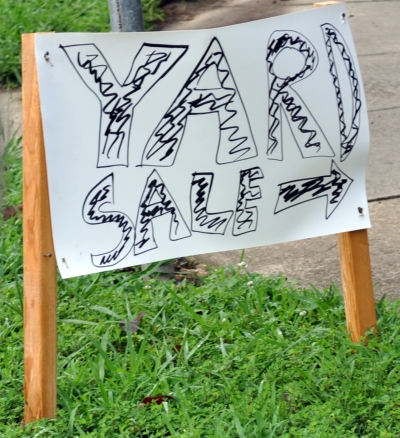
Yard Sale Signs

Garage Sale Signs at Entrance of Development

A Look at Signs for Garage/Yard Sales

Every Saturday morning my dad and I spend the early morning together.  We leave at 6:30 a.m. with fresh strong coffee in our travel mugs and go to Circle G, our favorite restaurant for breakfast.  We split the two egg platter.  We love how they fry their hash browns and toast their biscuits.  Sometimes we take a fresh tomato from our garden to go on the biscuits and other times dad brings some hog jowls.    


After we finish our breakfast at around 7:15 we head out in search for some good deals at local yard sales.  We have a route that we take each week that goes by several housing developments.  We depend on signs to draw us to the various garage sales.  Dad and I seem to discuss yard sale signs each week so I thought I would share some pointers that we discuss as we looking for some deals.

When hanging up your yard sale sign, use cardboard backing or something rigid since the morning humidity can curl the paper.  This happens offen and makes it difficult or impossible to be read.  Since Dad drives, sometimes I have time to get out of the car to uncurl the sign so we can read the information.  Many folks keep driving when they encounter a curled sign.  


Limit the words and graphics on the sign.  All folks really want to see it an arrow pointing in the direction of the sale.  All we could see of this sign was Garage Sale.  We were confused by all the arrows and additional information that was included.   Think of the must have information and include only that information in large letters.  You may want to drive by and see if you can read the information without stopping.  Most of the time the customer can't stop to read the sign, they can only slow down a little if traffic permits.

When your garage sale is in a large development make sure you put what I call encouragement signs along the way.  You will need to do this especially if your location is past a turn off for another sale location.  If you have two locations near each other, meet the other folks and agree to promote each other when talking to the customers.


Especially in the summer, it is best that you start your sale at 7:00 a.m. and have everything out by 6:45 a.m.  Most sales do start at 7 but there are others that start at 8 and I have even found some that start at 9.  

Most dedicated deal hunters have a route planned and won't hang around or come back after they leave if you are not ready to sell.  If folks come while you are sitting up, sell to them if your goal is to get rid of your stuff and make a little money.  Make a deal whenever possible since you are never assured that someone else will come and want the item.  People that go to yard sales want to make deals so don't be set on one price.  Be flexible and open to negotiating a price.

Don't expect folks to know where any streets are in your community.  Very often there are signs at entrances that give addresses but no arrows for directions.  The sign to the right says just past the pool but we could not find the community pool since we did not live there.

Remember, less is more.  All you really need is a sign with an arrow.  This is a good sign that lets you know needed information.  You can see that there is a sale, the direction, and the name of the street.  If you put out the signs in the morning and are starting early you don't need a time since folks will assume they can come on when they see the sign. Don't forget to remove the signs at the end of the day!

If you have additional pointers and tips about best practices in directing folks to yard sales, please submit a comment with the information!

Sunday, July 24, 2011

Summer Sport - Controlling Cicada Killer Wasp


A few years back, it looked like my yard had several large ant hills but on closer examination the dirt was pulled out of a hole to a burrow about the diameter of a quarter.  There were also lots of fast flying insects all around.  At first I thought they were hornets, they looked mean and just knew they would sting me if I got in their way.  I was wrong.  This morning I took my camera outside and took all these pictures to tell about this creature that annually invades my yard.


After doing some online research, I discovered that the insect was the eastern cicada killer wasp (Sphecius speciosus).   Each year they come back around the time the cicadas start making noises which seem to be around the middle part of July.  Pictured below is a cicada  that I found a female cicada killer wasp carrying.


 The female cicada killer wasp is larger than the male and is shown here shortly after her landing carrying a paralyzed annual cicada (Tibicen linnei) back to her burrow.  


I found that she puts it in a nest cell, lays an egg on it, and then seals the cell.  A grub will hatch from the egg in a few days, eat the cicada, and overwinter underground in a hard cocoon which it weaves. It will pupate in the spring, hatch in July or August, dig its way to the surface, and live above ground for 2-6 weeks before it dies.  


I spend time discovering ways to exterminate these creatures since they make major hills of dirt on my lawn.  I have tried to fill the holes with insulation foam which did not help so have never done that again.  I have tried to used wasp spray which with the wasps speed makes it very difficult to hit them with the stream of insecticide.  I finally discovered what works best for me.  I have two main pieces of equipment, scissors and a badminton racket.


I swat the badminton racket trying to hit a flying wasp.  I found that if I miss I keep on swinging and sometimes hit it on another pass since sometimes the wasp seem to be attracted to the movement.  I can hear when I hit a wasp.  I have the scissors to cut the wasp in half it I find it.

In the early mornings I find the females digging out their borrows. I spray insecticide down the hole the wait for a few seconds for the female to come out then I cut her in half with scissors.  
Below is a picture of a male cicada killer wasp.  A female can be twice the size of a male.  I hope that sometime I will be able to exterminate these so they don't come back year after year.


Update!  I went to Walmart on July 30,2012 and purchased a new tool I hope will be an excellent addition to my arsenal, a Bug Zapper racket for $7!  It takes two double A batteries and it has a button you press as your swing that runs electricity through the metal grids.   It kills the wasp on contact.

Wednesday, February 02, 2011

My Dad's Blog, A Three Year Father-Son Project

 
My father and I have been working on a joint project for the past three years. We started in November 2007 when my daughter shared that she was creating The Mauney Family Blog before her son Isaac was born. My brother Mike came over to his house one day and created this blog for him since he thought that everyone needed to have a blog. Dad said to him, "What in the world is a blog?" He shared it was quite easy for anyone to have with no cost. He told him that at this point in his 80 year old life, a blog was one thing that he did not need; Mike insisted that they create one then and there so it would be on his computer just in case my dad would ever wanted to write anything to share with the folks that had access to it on the Internet.


My dad thought long and hard about what he could do with a blog since he came from a time that you did not waste anything and I imagine that went for digital resources too.  He kept asking himself and other, "What can I ever do with a blog?"  

For years I had asked Dad to tell us more about when he was young growing up in the country so the rest of the family and I would know a little about his life when he was young. He knew that for the past several years, I had tried to get him to share stories about our family history so he jumped on this opportunity. That day he started to write about some of the things that he enjoyed doing.  That is how the story of his life unfolded. We committed to work on this project together as a father - son project and set a goal to post a new entry about his life each week and for it to be published every Sunday and that we would continue until he finished telling his story.   Each week, he sent me an e-mail  that contained the journal entry for the week, I would edit, and we would publish on the blog with pictures.

A couple times we thought we were finished, had a break, but continued to add more content.  He even posted stories of his parents and each of his siblings each week for three months.  I finally know which cousins belong to my aunts and uncles!

As this project developed, I enouraged him to make recordings of some of the stories to be linked within the blog.  Here is a link to some of the blog entries where there is audio of him telling the stories.  At this time he has over 70 stories!   For Christmas this year I had a copy of his blog printed.   A digital copy is below and a .pdf copy can be downloaded.


Monday, May 24, 2010

Geocaching Part 5: Creating My First Geocache Project

I have enjoyed being a member of the geocacher's community. When it comes to technology, I look for ways various digital tools can be used in the educational setting. This spring I created a project called Geocacher Surveys and finally opening it up for participation. I wanted to wait until the end of the 2009-10 school year which is a good time to prepare for use during 2010-11 and beyond.

In this project, students use surveys to collect and analyze data. This project uses geocaches to locate folks to take one or more of the surveys on this site. Once geocachers participate by taking a survey or two, they can drop the information card into another cache they visit to help spread the word.
I created a wiki with information about this project. There are several ways that teachers, students and geocachers can become part of this project:
  • create surveys that the results can be used in the classroom using Google Forms and set for everyone to be able to see the results
  • duplicate and distribute cards in caches
  • take surveys and pass the cards along
  • utilize/analyze the information submitted
This is a picture of the card.
It is my hope that you can participate in this project or send on to someone who you feel may be interested. Post replies to this post if you have other project ideas using geocaching!

Saturday, January 23, 2010

Geocaching Part 4: Creating My First Geocaches


After our vacation to Hilton Head Island, the Christmas season arrived and then it turned cold for a few weeks, really cold for North Carolina. I decided to become more of an active part in the geocaching community by creating a series of caches about Coulwood Hills, the community I live in. I have been an active part of Coulwood Community Council and even was the first webmaster, starting their first website. I created the Coulwood Hills Tour Series of four caches, each telling part of the history of our fifty year-old community starting with the first cache. As a bonus and encouragement to finish the series, each cache gave partial coordinates for the fifth and bonus cache.

I placed all created, filled all five caches placed them in their predetermined locations that I had found in the fall when I started thinking about the project and when poison ivy was visible... did not want to make the mistake like some have done and place it near this stuff I have been so allergic to all my life.

I used cookie tins and plastic containers with lids that have good seals. I will check them every few weeks to see which ones hold up the best. After I started geocaching, I looked for swag I could use around the house, stuff on sale at stores, and at yard sales. It does not take long to accumulate

LOTS of it. I always like to leave better swag than I take so I have all good stuff... so much, I was able to easily fill the five caches with three having themed goodies:

  • Cache 1 - General Content - largest cache
  • Cache 2 - Audio CDs
  • Cache 3 - Technology related stuff
  • Cache 4 - General
  • Cache 4 - Sports and Leisure

The caches were set out on Friday, January 15 in the morning and final approval by geocaching.com was finished at 6:30 a.m. The first to find the first cache was within two hours. During the first week, eight teams took the tour of Coulwood as they found the caches. There has been great response

and the finding the series and bonus can be done within an hour. To find the caches go to geocaching.com, Hide and Seek a Cache, then search for Hidden by Username, and enter glenngurley. It made true the statement, "If you build it they will come." I made sure I built this series the best I could to represent the community well.

Below is the graphics of the log sheets. Coordinates for the bonus cache are on the information sheets about the history of the Coulwood Hills Community.

One of the five pictures this family posted on the first geocache. Think they really enjoyed the spider glasses I had as swag in the cache.... Check the actual log on geocaching.com and see how they look on the puppy! Make sure you click on view all logs.